


I almost skipped Khewra Salt Mine the first time it came up on a travel list. “A salt mine” didn’t sound like much. Turns out that’s a bad way to judge it. It’s an actual working mine — salt is still being pulled out of the ground here.
People in the Salt Range still tell the same origin story, and I don’t know how much of it is true, but it’s stuck around for over two thousand years so it’s probably worth repeating. Around 320 BC, when Alexander’s army was passing through fighting Raja Porus, the horses apparently started licking rocks off the ground. Someone got curious, tasted it, realized it was salt. That’s it. That’s the whole discovery story. Make of it what you will.
Anyway. If you’re actually planning a Khewra salt mine tour and not just reading about it out of curiosity, here’s what you need — real timings, what it costs right now, the history that doesn’t usually make it into the brochure, and what the visit is actually like once you’re underground.
Where Is It, Exactly
Jhelum District, Punjab. Part of a hill system called the Salt Range that runs between the Jhelum and Indus rivers. Geologists nickname this whole belt the “Museum of Geology,” which sounds like marketing but genuinely isn’t — the rock layers here go back almost to the start of the planet’s geological record.
How you get there depends on your starting point.
Coming from Islamabad or Rawalpindi? It’s around 160 km, and depending on traffic you’re looking at 2.5 to 3.5 hours in the car.
From Lahore it’s a longer drive, and most people don’t do it alone — they pair it with Rohtas Fort so the whole day feels worth the distance.
Either way, most trips are structured as a full day out. Early pickup, long middle stretch, back home by evening.
The Part of the History Nobody Puts on the Poster
Everybody repeats the Alexander bit because it’s a fun story. Fewer people bring up what happened after. Local accounts say a tribal leader from Khewra eventually told the Mughal emperor Akbar about the deposits here, and that’s roughly when things shifted from informal salt gathering to actual organized mining.
Then the British arrived, and this is where it stops being a fun story. Records from the 1800s describe conditions that were, frankly, brutal — miners locked inside until quotas were met, including pregnant women and children, according to several accounts. When workers tried to strike over this, it wasn’t handled with any kind of restraint. In 1876, twelve miners were shot dead near the mine’s entrance during one of these protests. Their graves are still there today, near the middle gates. Walking past them changes how you think about the rest of the tour, honestly.
The site’s run by the Pakistan Mineral Development Corporation now. Salt’s still being extracted — this isn’t a museum pretending to be a mine, it’s a mine that lets people walk through part of it.
How Big Are We Talking
Eighteen operational levels. Tunnels running past 40 kilometers total, though tourists only get a small slice of that. Even the small slice feels big once you’re actually standing in it — numbers on a page don’t really translate to the feeling of it.
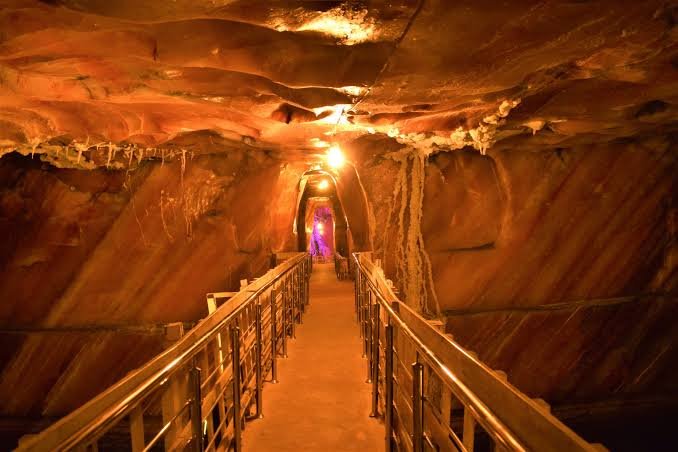
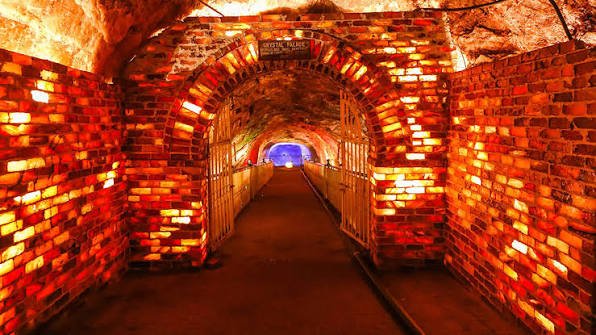
What gets you more than the size, though, is the color. Thick bands of deep red running against bright white, layered over millions of years of mineral buildup. Photos flatten it out completely. In person, the same stretch of wall can look totally different a few steps later depending on how the light’s hitting it.
Timings, and When You Should Actually Go
Open seven days a week, roughly 9 AM to 4 PM — though double-check before you leave, because hours do shift sometimes for maintenance.
October through March is generally the better stretch to visit. Cooler outside, shorter queues. But here’s the thing that surprised me doing this research: inside the mine, it sits around 18°C all year, no matter the season. So a July trip still means stepping into something cool and stable the second you go underground. The heat outside genuinely doesn’t reach in there.
Go early if you can, especially on weekends. Crowds build up fast once the tour buses start rolling in mid-morning.
What It Actually Costs
Entry has stayed fairly reasonable historically. Recent figures put it around Rs. 800 per person, though treat that as a rough estimate rather than something fixed — local authorities adjust these things periodically, and it’s always smarter to confirm right at the gate, or through a recent source, before you head out.
A few separate cost pieces to expect:
The base entry ticket gets you into the mine and the visitor tunnels. There’s usually a small extra fee for the train ride — worth paying, more on that below. Parking, if you’re driving yourself.
If arranging all of this feels like more effort than it’s worth, several operators out of Islamabad and Lahore run day trips bundling transport, a guide, and sometimes lunch into one price. Costs more than doing it solo. For a lot of people, it’s still worth it just to not think about logistics.
What Happens Once You’re Actually There
The train ride alone is worth showing up for. It’s a small narrow-gauge train that takes you deeper into the mine — slow, a little rattly, in a way that feels charming rather than sketchy. Works fine for pretty much any age; families with young kids ride it regularly. As it moves through the tunnels the salt walls catch whatever light’s around, and this is usually where the trip’s first real “oh, wow” moment happens.
After that, a guide takes the group through a series of lit tunnels and chambers, walking you through the mining process, pointing at interesting formations, dropping bits of history in along the way. Some chambers are lit specifically to bring the natural salt colors forward, which makes for a strange, genuinely striking visual — not really what you’d expect walking into what’s technically still an industrial site.
The guided portion generally runs 1.5 to 2 hours. Enough time to see the main tunnels and carved attractions without rushing, and enough time to actually take photos instead of just glancing and moving on.
The Stuff Worth Seeing
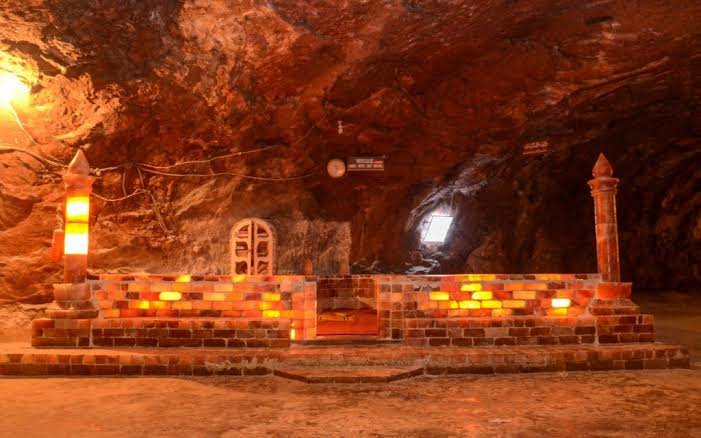
The salt mosque is the big one — modeled after Lahore’s Badshahi Mosque, except it’s built from salt blocks and lit from within. Almost certainly the most photographed corner of the entire mine, and it earns that reputation.
There’s also an illuminated bridge, crystal-like in structure, that you cross partway through — often lit in shifting colors, which makes for a strange couple of minutes that’s hard to explain until you’ve walked across it yourself.
The Salt Crafts Museum holds a collection of sculptures carved entirely from salt. Shows off a more artistic side of what’s otherwise a mining operation.
There are also therapy chambers built around the idea of breathing in the natural salt air — marketed for respiratory and general wellness benefits. Believe that as much or as little as you’d like. It’s a quiet moment regardless.
And there’s a larger underground hall, sometimes used for gatherings, along with a feature built to resemble a waterfall carved out of the salt formations.
Actually Planning the Day
From Islamabad or Rawalpindi, the usual flow: pickup around 8 to 8:30 AM, arrival by late morning, a few hours walking around, lunch either on-site or nearby, home by early evening.
From Lahore, people typically build the day around pairing Khewra with Rohtas Fort since they sit roughly along the same route. Longer day — out before 7:30 AM, back around 7 PM — but you get two major sites instead of just the one.
Independent visit or organized tour? Comes down to how much planning you want to deal with. Independent is cheaper, more flexible, more effort. Organized tours cost more, but transport, guiding, sometimes food — all of it’s handled for you.
Worth Adding to the Same Trip
Katas Raj Temples — a group of ancient Hindu temples built around a sacred pond. Commonly paired with a Khewra visit since they’re not far off.
Rohtas Fort — a UNESCO World Heritage Site, the usual pairing for anyone starting from Lahore.
Local salt factories and markets — worth stopping at to actually watch raw salt get turned into lamps and cooking blocks, and to grab souvenirs straight from where they’re made rather than a random shop later.
A Few Things Worth Knowing Before You Go
Wear shoes you don’t mind getting a bit dusty. The ground inside isn’t perfectly even everywhere. Bring something warm since it’s noticeably cooler underground than it is outside — easy to forget until you’re actually down there shivering slightly. If enclosed spaces genuinely bother you, think that through before committing to the whole walk; it’s not claustrophobic exactly, but it is underground. Keep kids close, running isn’t allowed, partly for safety and partly because this is still an active mining site rather than a museum built purely for show.
That last part’s worth sitting with for a second. You’re a guest in someone’s actual workplace here, not just wandering through a themed attraction built for tourists.
Questions People Usually Ask
- Is it actually safe down there? Yes. Well lit, guided, staffed. Families and older visitors go through regularly without any real issues coming up.
- How long should I plan for the tour itself? Around 1.5 to 2 hours for the guided section. A full day trip from Islamabad or Lahore, though, will eat up most of your day once travel time gets added in.
- Can I buy salt products there? Yes — shops near the entrance sell lamps, carved pieces, and other items made from the mine’s own salt.
- Good trip for kids? Generally, yes. The train ride especially tends to land well with younger visitors. Still worth keeping an eye on them given it’s underground and industrial.
- Best time of year, genuinely? October to March if comfort matters to you. But the stable interior temperature means it’s realistically doable any month.
One Last Thing
What stuck with me most about Khewra wasn’t the mosque or the bridge, impressive as both are. It’s that the place refuses to be just one thing. A legend about Alexander’s army. A Mughal-era mining site. A place where people died fighting for basic working conditions under colonial rule. And still, today, an active mine that happens to let people walk through a slice of it. That’s a lot to hold in one location, and it’s exactly why it’s worth going properly rather than treating it as one more stop on a checklist.